





Every October, the ICD-10-CM update gets filed under "the coders will handle it." This year, that habit could cost your agency money.
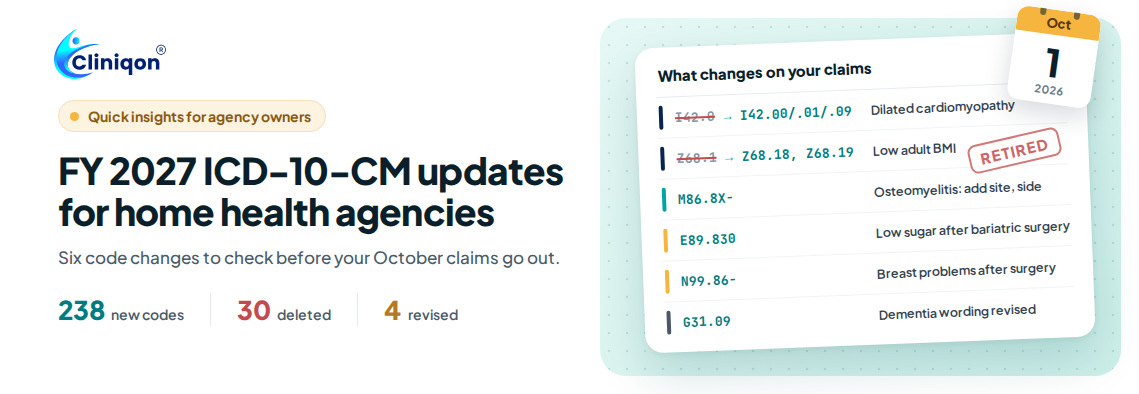
The FY 2027 code set was released on June 5, 2026, and takes effect on October 1. Most of it will never touch a home health chart. But a handful of changes land on patients you admit every week, and their impact doesn't stop at the code book. They reach your claims, your PDGM grouping, your documentation, your QA process, and ultimately your reimbursement.
The biggest risk isn't hiding in the new codes. It's in the familiar ones your team has typed a thousand times.
The 238 new entries include 48 non-billable headers. Totals follow the CMS FY 2027 release.
Where to focusBut which of these changes actually matter to home health?
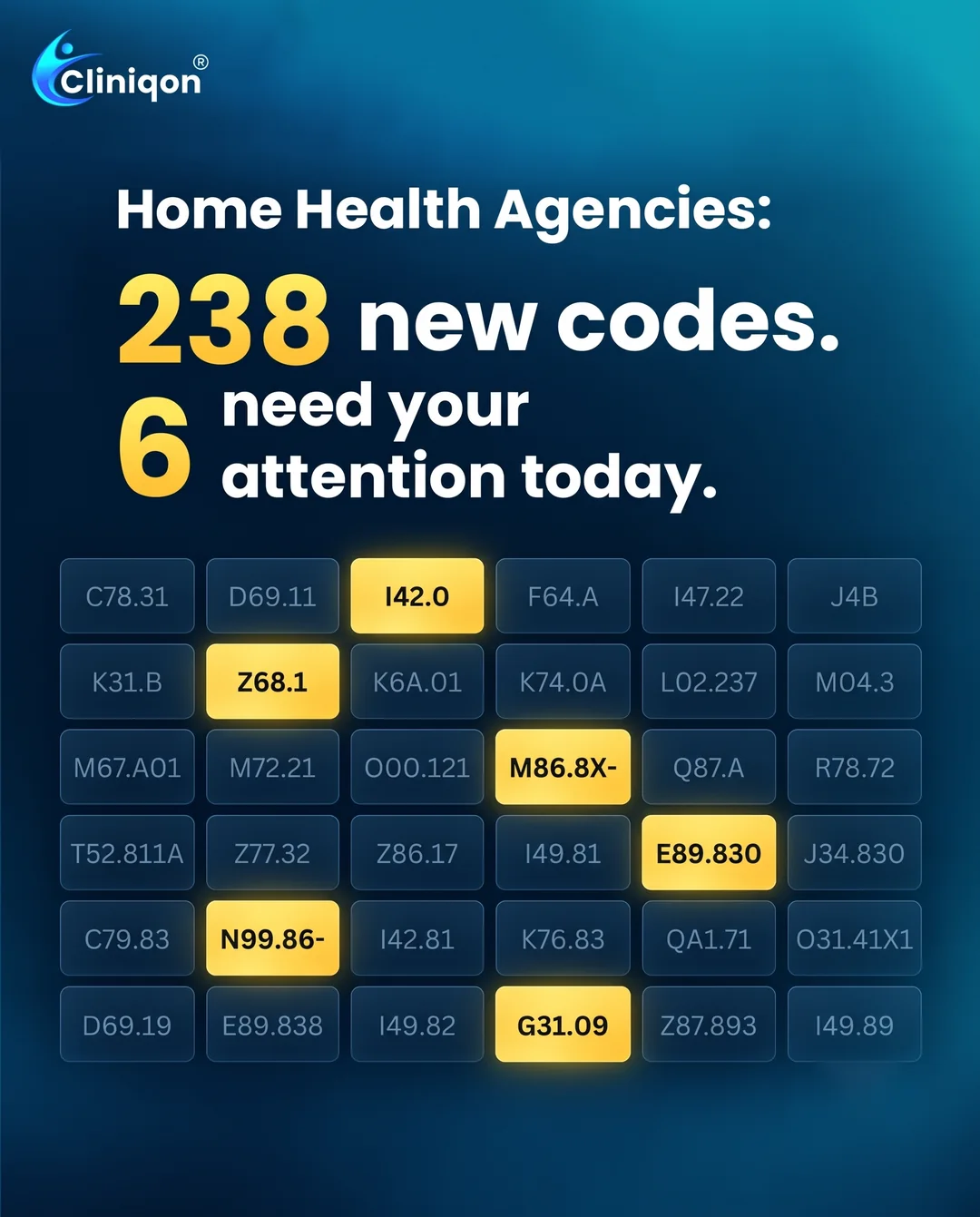
For most agencies, it comes down to six. Each card below shows what changed and the one thing to check before you bill. (Coders looking for every change can jump to the full FY 2027 code list.)
What this update means for your team
The big idea
Home Health Agency Coding Workflow May Require Review Before October 1
New codes get attention, so they usually get checked. The real exposure sits in the codes your team already uses every day: a diagnosis saved in your EMR favorites, a default in a referral intake template, or a code entered from memory after a full day of visits. If one of those stops being valid on October 1, nothing in your workflow will flag it. Your claims will.
“The code book brings in more stringent checks and balances. Your agency has to change the habits and systems built around it.
That's why FY 2027 readiness is an agency-wide operations task, not just a coding one. Here's where the update touches your agency:
What can go wrong
5 Ways FY 2027 ICD-10-CM Changes Can Hit Your Home Health Claims
After October 1, every claim runs through automated payer checks. For an agency owner, the problems below come down to two outcomes: cash that arrives late, or cash that's taken back later. Each card shows when you'll feel it and who owns the fix.
Dilated cardiomyopathy (I42.0) and low adult BMI (Z68.1) can't be billed on their own after October 1. Both are everyday diagnoses in home health, so bounced claims could show up in the first week.
Ask your team: Have the old codes been removed from every favorites list, template, and vendor pick list?
Osteomyelitis codes (M86.8X-) now need the body site, and the side where it applies. Wound care referrals often leave these out, and filling them in by guesswork is an audit finding waiting to happen.
Ask your team: Does intake ask for the site and side before the start of care?
In home health, the code set follows the patient's assessment/admission date, not the claim's through date. A patient assessed or admitted in September stays on the FY 2026 codes, even when the period runs past October 1. Assessments dated October 1 or later use FY 2027 codes. Systems that switch by through date will put the wrong year's codes on these claims.
Ask your team: Are our EMR and billing system picking the code set by the assessment/admission date, not the through date? Confirm current instructions with your MAC.
Invasive breast cancer (C50.-) and carcinoma in situ of the breast (D05.-) generally can't be reported together under the new Excludes1 note. Referrals that carry both need a closer look at the pathology and provider notes.
Ask your team: Are coders checking the pathology before a referral's codes go on the claim?
The new codes for low blood sugar after bariatric surgery (E89.830) and nipple complications after breast surgery (N99.86-) only apply when the doctor links the problem to the surgery. Without that link, the claim may pay now and be taken back in a later review.
Ask your team: Do we send a provider query before billing when that link is missing?
G31.09 keeps its code, but its description now reads "other frontotemporal neurocognitive disorder." If you care for dementia patients, carry the new wording into coding references, care plans, and training so the whole record tells one consistent story.Why timing matters
The First Two Weeks After October 1 Decide What Rejections Cost You
None of these changes is complicated on its own. What decides the cost is how fast you catch them. Many rejections can be spotted and fixed right away, but only if someone is watching. Left alone for a few weeks, one small error repeats on every claim that follows.
Your October 1 to 14 watch plan
Your game plan
Assign an Owner to Every Step Before October 1
Whether your QA is handled in-house or through outsourced home health QA, these five steps cover the work. Tick them off as you go.
Five-step checklist for your home health agency's ICD-10-CM FY 2027 readiness
What your October QA sample should check
In practice
Speed and Accuracy: The Balance Your Coding Team Has to Hold
Updates like FY 2027 put three pressures on a home health agency at once: a growing code set, tighter accuracy expectations, and turnaround times that drive cash flow and compliance.
Leading agencies now combine AI-driven chart parsing with expert clinical review to reach 24-hour turnaround without trading away accuracy, even during referral surges.
This article covers what agencies need to act on. For every new, deleted, and revised code, use the official files as your reference: CMS 2027 ICD-10-CM files (addendum, tabular, index) and CDC NCHS ICD-10-CM files.
Let's talk
Make October 1 a Non-Event for Your Agency
This article highlights selected changes and is for education only. Always code from the official FY 2027 code set, the ICD-10-CM Official Guidelines for Coding and Reporting, and AHA Coding Clinic.




Recommended Articles
Sep, 2026 The Quiet Work Behind Every Home Health Admission
Read MoreSep, 2026 What Your Pre-Bill Audit May Be Telling You
Read MoreSep, 2026 The ABA Capacity Gap: Why Growing Providers Struggle to Turn Demand into Delivered Care
Read MoreJul, 2026 Why Payment Posting Is One of the Most Overlooked Yet Critical Functions in Revenue Cycle Management
Read MoreMay, 2026 Why More Home Health Agencies Are Choosing to Outsource Medical Coding Services
Read MoreMay, 2026 Home Health RCM Process Optimization: Step by Step Process to Increase Claim Approval
Read MoreMay, 2026 How AI is Transforming Revenue Cycle Management in Home Health and Hospice Care
Read MoreMay, 2026 Signs Your Home Health Agency Needs Coding Support Services
Read MoreMar, 2026 Smarter administration and smoother operations for improved cash flow management
Read MoreFeb, 2026 How Applied Behavior Analysis (ABA) Clinics can better manage their revenue cycle with the right partners
Read MoreJan, 2026 Eliminating Documentation Burnout: Using AI to Solve Home Health and Hospice Coding & QA Challenges
Read MoreJan, 2026 Eliminating Documentation Burnout: Using AI to Solve Home Health and Hospice Coding & QA Challenges
Read More