



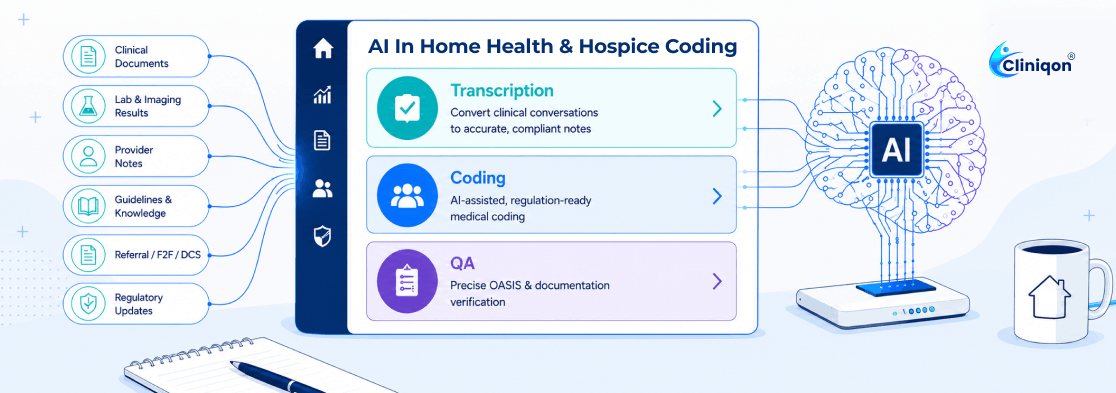


Artificial Intelligence is rapidly optimizing home health and hospice agency operations through automating and accelerating these three core processes:
-
Patient Transcriptions
-
Medical coding
-
Coding QA
Traditionally, these three processes have been highly time-consuming and challenging. A home health agency needs to follow regulatory updates while trying to maintain a manageable workload.
By integrating AI-driven tools into their overall clinician and back-office workflow, agencies can now free up more time to be utilized on patient care while not compromising on compliance or operational efficiency. By blending AI-driven workflow improvements with the seasoned judgment of RNs and clinical experts, hospice agencies can deliver the precision required by today’s regulatory climate. In this way, it's possible to safeguard clinical integrity while drastically cutting the time spent on manual chart audits.
Challenges with AI Implementation in Home Health/Hospice
Here are the major challenges with implementing AI in the Home Health/Hospice environment:
-
HIPAA-Compliant Security: Engineered with rigorous data privacy standards to safeguard sensitive patient information at every step.
-
Workflow-Aware Coding Precision: Built around real-world clinical operations to seamlessly translate MD-signed real-world source documentation (like F2F and referral/DCS) into accurate medical codes, while comparing clinical narratives to safeguard accuracy.
-
High Fidelity RAG Architecture: Employs a robust Retrieval-Augmented Generation (RAG) pipeline that ingests clinical data, anchoring the AI strictly to your source documents for a high percent reduction in hallucinations.
-
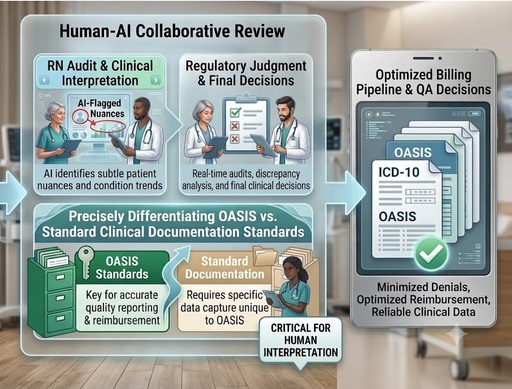
Empowering RNs and Certified Coders: The system needs to integrate expert human validation checkpoints directly into the workflow. This allows clinical teams to audit AI suggestions and correct discrepancies in real-time, ensuring that only flawless, compliant coding enters your billing pipeline.
-
Patient Care OASIS Verification:
-
Precise OASIS verification: Rectify the OASIS fields with comparison to standard clinical documentation.
-
Augment human expertise: While human oversight provides the final validation, AI serves as the assisted intelligence driving clinical interpretation, regulatory judgment, and precise coding and QA decisions.
-
The Case for AI-Driven Home Health and Hospice Transcripts
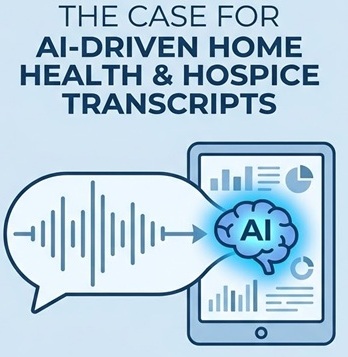
Due to strict HIPAA regulations, standard transcription software like Otter.ai cannot be used for medical dictation because they do not sign a Business Associate Agreement (BAA). Instead, clinics must choose a specialized, HIPAA-compliant AI solution that provides a BAA while streamlining clinical documentation. A dedicated medical transcription service enables providers to securely record clinical conversations. These transcripts are then cross-referenced against physician-signed documents—including Face-to-Face (F2F) encounters and referral/DCS forms—to ensure clinical alignment prior to the final coding audit conducted by a Registered Nurse (RN).
If you achieve higher levels of data fidelity in capturing patient encounters, it can directly lead to better clinical outcomes and satisfaction. These include faster coding turnaround, bulletproof compliance, and significantly improved operational ROI. This guide details proven strategies for streamlined transcription, workflow integration, and seamless information-to-code transformation in both home health and hospice care. Cliniqon’s all-in-one platform helps you maintain flawless documentation with built-in HIPAA-compliant speech-to-text and a 100% hallucination-free RAG pipeline. This augments a dedicated team of RNs working on coding and QA, significantly improving their efficiency and speed.
In this way, we help you align clinical conversations with MD‑signed source documentation to generate precise, fully compliant medical codes. This allows you to significantly increase the time spent on patient care without back-office documentation bottlenecks or tool sprawl.
The Case for AI-Enhanced Home Health and Hospice Coding
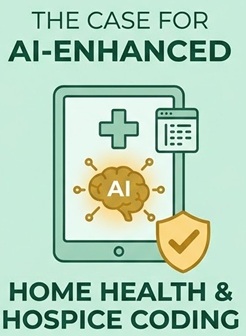
Home health and hospice coding requires maintaining standards set by payers, CMS mandates, value-based care models, and constantly shifting state-level policies. With rising patient volumes, these stringent coding requirements are simply too hard to meet.
In this situation, it’s ideal to combine human expertise and AI-enhanced efficiency in managing patient codes. These experts shoulder the administrative heavy lifting, transforming complex clinical notes into flawless, audit-ready data so agencies can scale safely—free from the threat of billing delays.
Integrating AI into this workflow supercharges human coders by:
-
Slashing Administrative Waste: Instantly automating routine QA checks to save time.
-
Preventing Costly Denials: Flagging documentation inconsistencies before they trigger billing or compliance issues.
-
Systematizing Compliance: Enforcing unified, rules-based compliance across all clinical charts.
The result is a scalable, audit-resistant operational model that protects your agency's financial health without sacrificing regulatory accuracy.
The Case for AI in Home Health Coding & QA Workflows - Coding, OASIS, HOPE, and POC
By removing administrative bottlenecks and accelerating chart turnaround times, integrated AI workflows optimize clinical quality outcomes and elevate overall agency performance. Here are some cases of overall workflow improvements with AI:
1. Medical Coding & QA
-
Suggests ICD-10-CM codes strictly from MD-signed documents (F2F and referral/DCS)
-
Cross-references and compares the Plan of Care / Form of Care (POC/FOC) with clinical narratives to ensure alignment and clinical integrity
-
Flags unsupported diagnoses or documentation inconsistencies
-
Improves first-pass accuracy through QA validation
2. OASIS & HOPE Review
-
Identifies missing or inconsistent data elements
-
Supports inter-record consistency
-
Improves quality scoring and reduces resubmissions
3. Plan of Care (POC) QA
-
Ensures alignment between diagnoses, services, and goals
-
Improves clarity, completeness, and clinical justification
-
Supports timely approvals and care continuity
Maximizing Clinical Outcomes: Benefits of Implementing AI Into Home Health and Hospice Workflows
AI adoption is driven by both operational and compliance pressures, including:
-
Rising patient volumes across home health and hospice
-
Increased scrutiny from CMS and accrediting bodies
-
Demand for real-time documentation accuracy
-
Pressure to reduce denials, resubmissions, and audit risk
In a fast-paced clinical environment, leveraging AI helps bridge the gap between heavy patient volumes and documentation accuracy. By catching missing data points early and refining code selection, our specialized home health coding services help agencies maintain a smooth revenue cycle without the typical administrative bottlenecks.
This level of precision is especially critical for providers looking to scale operations while remaining fully compliant with rules and regulations.
So, the question is: How does Cliniqon's AI-powered coding and QA deliver faster, more accurate outcomes for home health and hospice agencies?
Without further ado, here’s a sneak peek into our entire coding workflow.
Inside Cliniqon’s Human-AI Coding Synergy Model
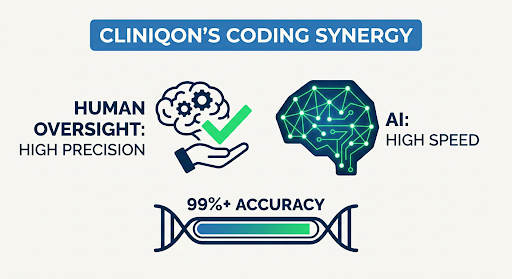
While AI models are undeniably faster, they still fall short of the high precision required for home health coding and QA. Because accurate coding is critical to getting paid by insurance, relying solely on AI can lead to denied claims and lost revenue. Cliniqon solves this by combining AI speed with human oversight. This team-up maintains a quick workflow while ensuring over 99% accuracy.
Human‑in‑the‑Loop AI Model for Home Health and Hospice Coding
A human‑in‑the‑loop AI coding model accelerates workflows through AI‑assisted home health coding and QA services, all while maintaining high accuracy for coding-related activities. This model drives improvements across multiple areas: coding, OASIS review, coding QA, and Plan of Care development.
In this model, an AI model trained on home health and hospice coding undertakes AI support documentation analysis, coding validation, and workflow prioritization. Each AI model workflow is overseen by a team of experienced clinical and coding professionals who maintain oversight to ensure accuracy and regulatory alignment.
An Integrated AI-Workflow for Home Health Coding
The human-AI integrated workflow works in two phases:
In the first phase, the AI model streamlines documentation, coding, and prioritization. The self-correcting agentic model reviews all documents associated with the patient with high security and HIPAA compliance to evaluate forms with high-quality output.
In the second stage, experienced clinical and coding professionals review the deliverables to ensure there are no gaps. This maintains absolute accuracy and regulatory compliance across the entire process. At the end, the outcome is home health and hospice codes ready for submission.
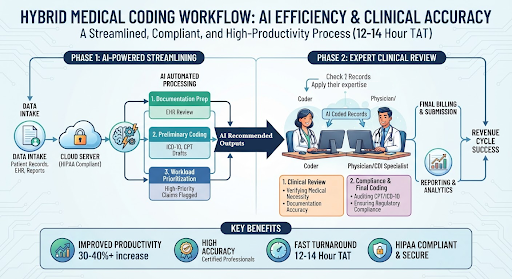
By maintaining this hybrid two-phased approach, it’s possible to preserve a high level of accuracy while improving the productivity of the coding team.
Conclusion
Artificial intelligence is transforming traditional coding-to-billing workflows in the home health industry, as much as it has in other sectors. However, while AI offers extensive possibilities for homecare and hospice, integrating it safely remains a major hurdle due to strict HIPAA mandates and the non-negotiable demand for >99% accuracy.
An integrated AI workflow can support documentation analysis, coding validation, and human prioritization, while experienced clinical and coding professionals maintain oversight to ensure accuracy and regulatory alignment.


Recommended Articles
Sep, 2026 The ABA Capacity Gap: Why Growing Providers Struggle to Turn Demand into Delivered Care
Read MoreJul, 2026 Why Payment Posting Is One of the Most Overlooked Yet Critical Functions in Revenue Cycle Management
Read MoreMay, 2026 Why More Home Health Agencies Are Choosing to Outsource Medical Coding Services
Read MoreMay, 2026 Home Health RCM Process Optimization: Step by Step Process to Increase Claim Approval
Read MoreMay, 2026 How AI is Transforming Revenue Cycle Management in Home Health and Hospice Care
Read MoreMay, 2026 Signs Your Home Health Agency Needs Coding Support Services
Read MoreMar, 2026 Smarter administration and smoother operations for improved cash flow management
Read MoreFeb, 2026 How Applied Behavior Analysis (ABA) Clinics can better manage their revenue cycle with the right partners
Read MoreJan, 2026 Eliminating Documentation Burnout: Using AI to Solve Home Health and Hospice Coding & QA Challenges
Read MoreJan, 2026 Eliminating Documentation Burnout: Using AI to Solve Home Health and Hospice Coding & QA Challenges
Read MoreOct, 2025 How important is Efficient Revenue Cycle Management for Healthcare Providers?
Read MoreAug, 2025 Navigating the New HOPE Tool: What Hospice Agencies and Clinicians Need to Know Before October 1st.
Read More