



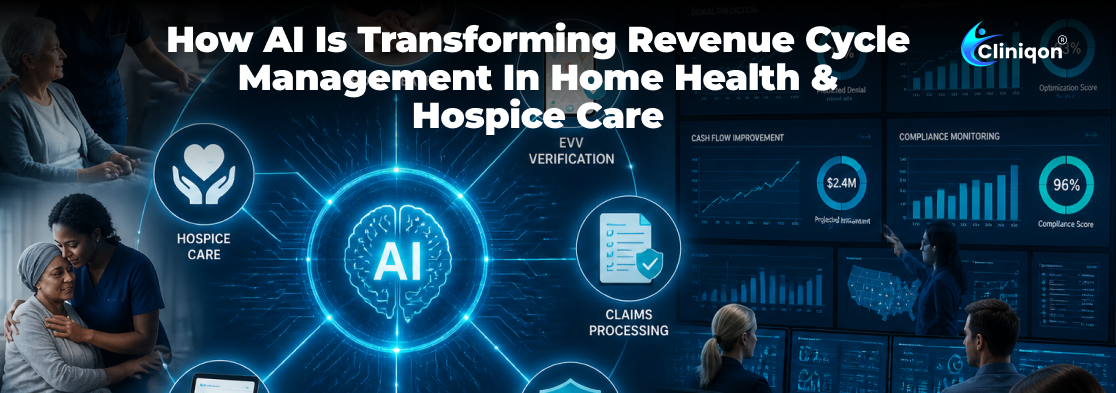


How AI is Transforming Revenue Cycle Management in Home Health and Hospice Care
Across today’s healthcare landscape, businesses are actively seeking new and innovative ways to navigate a wide range of persistent headwinds, including budget shortfalls, shrinking margins, evolving care delivery models, workforce shortages, and an increasingly complex regulatory environment. While traditional cost-cutting measures can offer short-term relief, they often fall short of addressing the deeper structural inefficiencies that disrupt cash flow and reduce financial predictability.
These challenges are especially pronounced in home health and hospice care, where reimbursement is highly dependent on documentation accuracy, visit compliance, and strict regulatory requirements such as Medicare Conditions of Participation, OASIS assessments, EVV (Electronic Visit Verification), and hospice eligibility certifications.
Within this already complex environment, a major contributor to financial instability is workflow friction within the revenue cycle - driven by fragmented systems, field-based documentation delays, administrative complexity, and inefficient payer contract management. These inefficiencies not only slow down reimbursements but also place additional strain on clinicians, billing teams, and operational staff who are already stretched thin.
As competition intensifies across the post-acute care ecosystem, the pressure on leaders to ensure financial sustainability while maintaining high-quality patient care has never been greater. In response, artificial intelligence or AI in revenue cycle management services is emerging as a transformative force in healthcare, particularly for home health and hospice agencies seeking to improve accuracy, reduce denials, and strengthen cash flow predictability.
For finance and operations leaders in this space, AI in revenue cycle management is quickly becoming a strategic lever to enhance financial resilience while supporting better patient outcomes.
What is Revenue Cycle Management in Home Health and Hospice
Traditionally viewed as a back-office function, Revenue Cycle Management in home health and hospice encompasses every financial step of the care journey, starting from patient intake and eligibility verification to visit documentation, coding, claims submission, and reimbursement.
However, unlike acute care settings, post-acute RCM is deeply influenced by field-based operations and documentation-driven reimbursement models. Care is delivered in patient homes, often across multiple visits, with clinical documentation completed outside centralized systems. This creates natural delays, inconsistencies, and higher exposure to claim errors.
In home health, for example, OASIS documentation plays a critical role in determining reimbursement accuracy. In hospice care, eligibility certification and recertification cycles must be rigorously maintained to ensure compliance. Even minor documentation gaps or timing errors can result in claim denials or payment delays.
As denial rates continue to rise across the industry, many providers report that a significant portion of claims face rejection or require rework before payment is received. In such an environment, RCM is no longer just a financial process - it is a clinical-financial coordination challenge.

Key Challenges in Home Health and Hospice RCM
Home health and hospice providers face several revenue cycle challenges, including:
-
Incomplete or delayed clinical documentation
-
EVV mismatches
-
Claim denials caused by documentation errors
-
Complex Medicare and payer requirements
-
Hospice eligibility and recertification complexities
-
Manual billing and follow-up processes
-
Limited visibility into claim status
These inefficiencies result in:
-
Slower reimbursement cycles
-
Increased accounts receivable (AR) days
-
Higher administrative costs
-
Revenue leakage
-
Reduced staff productivity
As margins continue to tighten, improving RCM efficiency has become essential for financial sustainability.
How AI is Transforming Revenue Cycle Management in Healthcare
Artificial intelligence introduces a fundamental shift in how revenue cycle processes are managed in post-acute care. Instead of relying on reactive corrections after claims are submitted, AI enables proactive validation, prediction, and continuous optimization across the entire workflow.
By leveraging machine learning, natural language processing (NLP), and advanced analytics, AI in revenue cycle management systems can connect clinical documentation, operational workflows, and financial processes into a unified intelligence layer. This allows agencies to move from fragmented, manual processes to predictive and self-correcting revenue cycles.
Pre-Claim Documentation Review
AI can analyse clinical and billing documentation such as visit notes, OASIS assessments, physician orders, plan of care, certifications, and supporting clinical records to detect missing, incomplete, inconsistent, or non-compliant information before claim submission. It strengthens pre-billing validation by ensuring all required documentation and billing elements are complete, accurate, and aligned with payer rules.
For Home Health, this includes validating patient demographics and insurance details, verifying active eligibility and coverage, confirming physician’s order, ensuring Face-to-Face (F2F) requirements are met, and confirming OASIS is completed, locked, and transmitted. It also checks certification periods, visit notes are signed and dated, diagnosis codes are accurate, and HIPPS and revenue codes are correctly assigned. In addition, it validates units, dates of service, and charges, confirms prior authorization requirements where applicable, ensures NOA has been submitted and accepted before claim submission, and performs a final claim-level accuracy check prior to billing.
For Hospice, AI ensures patient demographics and insurance eligibility are verified, physician certification of terminal illness is signed and dated, and hospice election statements are properly completed and signed. It confirms admission date and benefit period assignment, verifies NOE submission and acceptance, and checks visit documentation and services rendered for completeness. It further validates revenue codes, level of care, diagnosis coding accuracy, supporting clinical documentation, units, dates of service, and charges. It also ensures any required authorizations are in place and performs a final claim accuracy and compliance check before submission to reduce denials and improve first-pass acceptance rates.
EVV and Visit Compliance Reconciliation
For home health agencies, AI can automatically detect mismatches between EVV records and clinical documentation, preventing claim rejections related to visit validation issues.
Denial Prediction and Prevention
Machine learning models identify patterns that historically lead to denials, allowing teams to correct issues before submission. This is especially valuable in Medicare-heavy environments.
Home Health and Hospice Eligibility and Recertification Monitoring
AI can flag patients at risk of eligibility issues by analysing clinical progression trends, helping teams proactively manage recertification requirements and avoid reimbursement disruptions.
Intelligent Claims Processing and Coding Support
NLP tools ensure that documentation supports medical necessity and aligns with coding standards, reducing errors that commonly lead to denials.
AR Prioritization and Cash Acceleration
AI-driven AR systems prioritize claims based on payer behavior, probability of payment, and aging trends - helping agencies accelerate cash flow in a highly episodic reimbursement environment.
Benefits of AI in Revenue Cycle Management
The most significant shift AI enables is not just operational efficiency, but structural transformation of the revenue cycle itself.
Home health and hospice agencies move from:
- reactive denial management → proactive denial prevention
- manual documentation review → automated validation
- delayed billing cycles → real-time claim readiness
- fragmented workflows → connected financial intelligence
This transformation allows agencies to generate more predictable revenue without increasing patient volume or adding administrative burden. In an industry where workforce shortages are persistent and reimbursement complexity is increasing; this shift is not optional, but it is essential for long-term sustainability.
How Cliniqon's RCM Services Help Home Health and Hospice Organizations
Cliniqon specializes in AI-driven Revenue Cycle Management solutions for home health and hospice organizations, helping providers transform complex financial workflows into intelligent, automated systems.
With deep expertise in post-acute care operations, Cliniqon enables organizations to:
-
Reduce claim denials and revenue leakage
-
Improve OASIS and hospice documentation accuracy
-
Strengthen EVV compliance and visit validation
-
Accelerate reimbursement cycles
-
Optimize end-to-end revenue cycle performance
By combining healthcare domain expertise with advanced AI capabilities, Cliniqon helps home health and hospice providers move from fragmented RCM processes to a connected, intelligent, and high-performing revenue cycle ecosystem.
In Summary
AI is fundamentally transforming Revenue Cycle Management in home health and hospice care. By improving documentation accuracy, predicting denials, automating workflows, and optimizing financial operations, AI enables providers to achieve stronger cash flow and long-term financial sustainability.
As the complexity of post-acute care continues to grow, AI-powered RCM solutions will become essential for survival and growth - not optional enhancements. Cliniqon stands at the forefront of this transformation, enabling home health and hospice organizations to build smarter, faster, and more resilient revenue cycle systems.
Ready to build a smarter, more resilient revenue cycle? Schedule a consultation with Cliniqon today.




Recommended Articles
May, 2026 Why More Home Health Agencies Are Choosing to Outsource Medical Coding Services
Read MoreMay, 2026 Home Health RCM Process Optimization: Step by Step Process to Increase Claim Approval
Read MoreMay, 2026 Signs Your Home Health Agency Needs Coding Support Services
Read MoreMar, 2026 Smarter administration and smoother operations for improved cash flow management
Read MoreMar, 2025 How to Prevent Common Errors in Home Health and Hospice Coding
Read MoreDec, 2024 Home Care Trends to Watch For in 2025
Read MoreNov, 2024 Key Updates in the CY 2025 Home Health Prospective Payment System Final Rule
Read MoreOct, 2024 The Final Rule for Home Health Prospective Payment System for 2024 - Including a 0.8% Payment Increase and More
Read MoreSep, 2026 ICD-10-CM FY 2027 October 1 Updates: 6 Changes Home Health Agencies Need to Know
Read MoreSep, 2026 The Quiet Work Behind Every Home Health Admission
Read MoreSep, 2026 What Your Pre-Bill Audit May Be Telling You
Read MoreSep, 2026 The ABA Capacity Gap: Why Growing Providers Struggle to Turn Demand into Delivered Care
Read More