






Why Payment Posting Is One of the Most Overlooked Yet Critical Functions in Revenue Cycle Management
Revenue cycle performance is often evaluated through highly visible metrics - denial rates, days in accounts receivable, clean claim percentages, and reimbursement turnaround times. Yet one function with an outsized influence on financial performance continues to receive comparatively little attention: payment posting.
For many healthcare organizations, payment posting is viewed as the final administrative step in the claims lifecycle - a necessary process to record payments and close the loop. In practice, it serves a much broader purpose. Every payment posted validates reimbursement, reveals payer behavior, confirms contractual performance, and provides the financial data leaders depend on to evaluate revenue cycle health.
When payment posting lacks consistency or accuracy, the consequences extend far beyond accounting. Underpayments remain undetected, patient balances become inaccurate, credit balances accumulate, payer trends go unnoticed, and opportunities to recover earned revenue are missed. Even organizations with strong coding practices and high clean claim rates can experience significant revenue leakage if payment posting fails to identify reimbursement discrepancies.
As reimbursement models become more complex and payer scrutiny continues to increase, healthcare organizations can no longer afford to view payment posting as a transactional back-office activity. It is a financial control point that protects revenue integrity, strengthens operational visibility, and enables better decision-making across the revenue cycle.
Payment Posting Is Where Revenue Is Validated
Healthcare organizations invest heavily in improving front-end revenue cycle performance. They optimize documentation, strengthen coding accuracy, streamline claims submission, and reduce denial rates. These efforts are essential - but they answer only one question:
Was the claim submitted correctly?
Payment posting answers a different - and arguably more important question:
Was the organization reimbursed correctly?
That distinction matters.
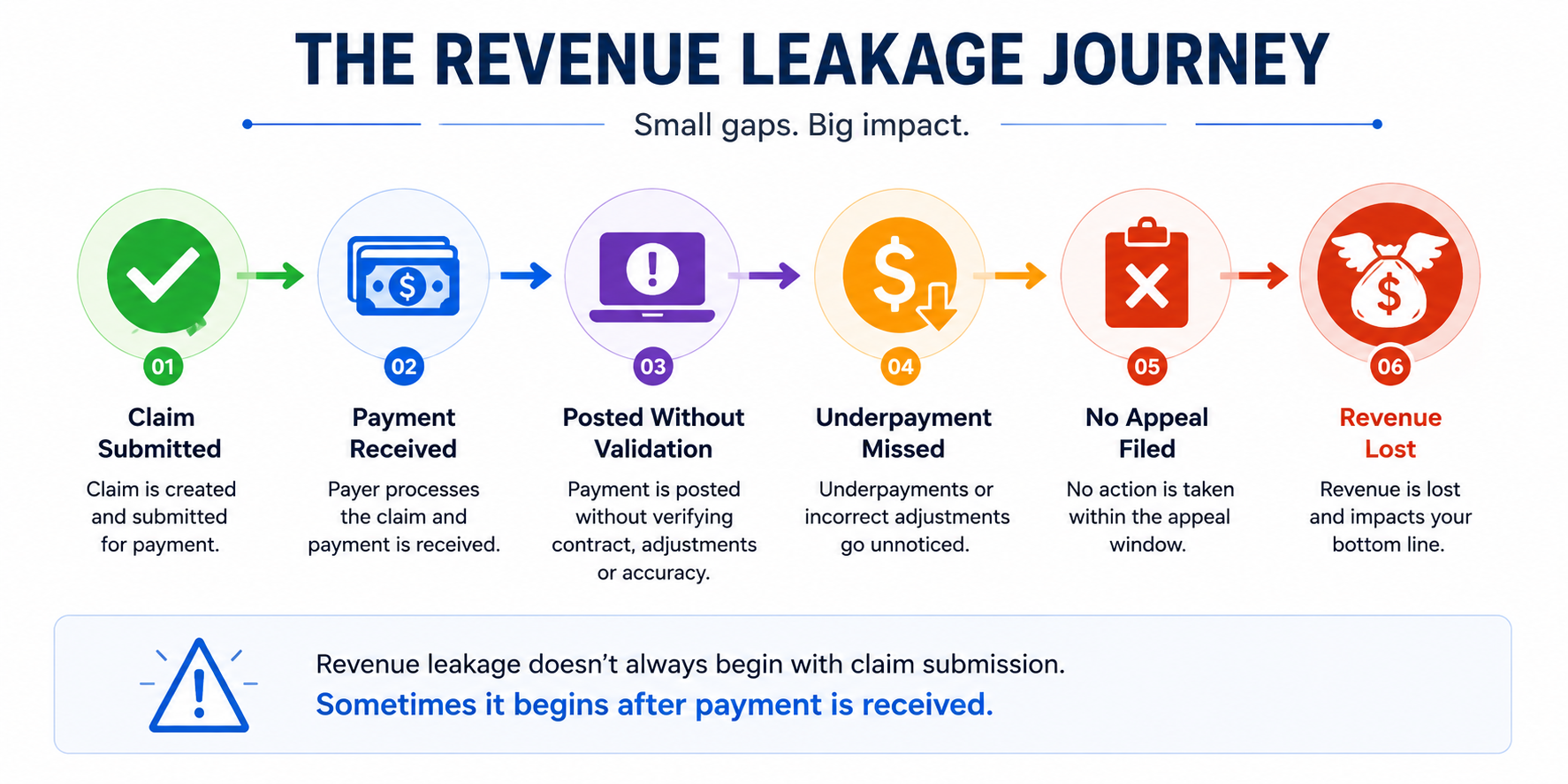
Submitting a clean claim does not guarantee accurate reimbursement. Every payment received represents the payer's interpretation of the claim, the contract, coverage policies, and patient responsibility. Unless those payments are validated, organizations cannot know whether they have received the revenue they were entitled to collect.
In this sense, payment posting is not the end of the revenue cycle. It is the point at which the success of every preceding activity is ultimately confirmed.
The Hidden Cost of Treating Payment Posting as Administrative Work
Many organizations still approach payment posting as a transactional process focused primarily on speed and volume. Payments are entered, adjustments are applied, balances are updated, and work moves to the next claim.
That approach prioritizes completion over insight.
Every remittance contains information that extends beyond payment amounts. Electronic Remittance Advices (ERAs) and Explanation of Benefits (EOBs) reveal how payers interpret contracts, apply adjustments, process denials, assign patient responsibility, and reimburse services.
When this information is simply recorded rather than analyzed, valuable intelligence is lost.
Over time, organizations may unknowingly accept recurring underpayments, overlook payer inconsistencies, delay appeals, and base financial decisions on incomplete reimbursement data. The impact is rarely immediate. Instead, it appears gradually through declining margins, slower cash flow, and growing administrative effort.
Revenue leakage often occurs not because organizations fail to submit claims - but because they fail to validate payments.
Payment Posting Creates Financial Intelligence
Viewed strategically, payment posting becomes much more than a reconciliation process. It becomes one of the richest sources of operational insight within the revenue cycle.
Consistent analysis of payment activity helps organizations answer questions such as:
- Are payers reimbursing according to contract?
- Which denial reasons are increasing over time?
- Are certain services consistently underpaid?
- Where are adjustment patterns changing?
- Are patient balances being calculated accurately?
- Which operational issues are contributing to downstream reimbursement problems?
The answers influence far more than accounts receivable.
They inform payer contracting discussions, denial management strategies, coding quality initiatives, compliance efforts, patient financial services, and executive financial planning. In many organizations, payment posting provides the earliest indication that a reimbursement issue is emerging.
Technology Has Increased Speed - Not Eliminated Judgment

Automation has fundamentally improved payment posting. ERA automation, intelligent payment matching, and workflow technologies have significantly reduced manual effort while accelerating posting speed.
What automation has not replaced is financial judgment.
Technology can record payments efficiently, but it cannot determine whether a payer reimbursed according to contract, whether an adjustment is appropriate, or whether a recurring payment variance represents an emerging trend.
As automation continues to advance, experienced reimbursement professionals become more valuable - not less.
Their role shifts from entering transactions to interpreting financial outcomes, resolving exceptions, and identifying opportunities to strengthen revenue performance.
The organizations achieving the greatest return from automation are those that combine technology with standardized processes and experienced revenue cycle expertise.
Payment Posting Reflects the Health of the Entire Revenue Cycle
One of the most overlooked aspects of payment posting is that it reflects the effectiveness of every process that came before it.
Repeated denial patterns may point to documentation deficiencies.
Unexpected adjustments may indicate coding inconsistencies.
Recurring eligibility issues may reveal registration gaps.
Frequent authorization denials may expose workflow breakdowns earlier in the patient journey.
Payment posting does not create these problems - but it often reveals them first.
Organizations that treat payment data as operational feedback can identify systemic issues before they become persistent financial challenges. Rather than functioning solely as an accounting process, payment posting becomes a continuous improvement mechanism for the entire revenue cycle.
A Strategic Shift for Revenue Cycle Leaders
As reimbursement models continue to evolve, healthcare organizations will need greater visibility into how revenue is earned, validated, and protected.
That requires moving beyond the traditional view of payment posting as a back-office administrative task.
Instead, revenue cycle leaders should view payment posting as a strategic financial control that validates reimbursement accuracy, identifies emerging risks, strengthens operational decision-making, and improves long-term financial performance.
Organizations that make this shift are better positioned to detect revenue leakage earlier, improve payer accountability, maintain cleaner financial data, and build more resilient revenue cycle operations.
Final Thoughts
Every claim represents expected revenue. Every payment confirms whether that expectation became reality.
Payment posting is the point where reimbursement is validated, payer performance becomes visible, and financial accuracy is either strengthened or compromised. It is not simply where payments are recorded - it is where revenue integrity is measured.
At Cliniqon, we believe payment posting should be treated as a strategic component of revenue cycle management, not an administrative afterthought. By combining experienced revenue cycle professionals, standardized workflows, and technology-enabled processes, we help healthcare organizations transform payment posting into a source of financial intelligence - protecting revenue, improving visibility, and supporting stronger operational performance across the entire revenue cycle.


Recommended Articles
Sep, 2026 The ABA Capacity Gap: Why Growing Providers Struggle to Turn Demand into Delivered Care
Read MoreMay, 2026 Why More Home Health Agencies Are Choosing to Outsource Medical Coding Services
Read MoreMay, 2026 Home Health RCM Process Optimization: Step by Step Process to Increase Claim Approval
Read MoreMay, 2026 How AI is Transforming Revenue Cycle Management in Home Health and Hospice Care
Read MoreMay, 2026 Signs Your Home Health Agency Needs Coding Support Services
Read MoreMar, 2026 Smarter administration and smoother operations for improved cash flow management
Read MoreFeb, 2026 How Applied Behavior Analysis (ABA) Clinics can better manage their revenue cycle with the right partners
Read MoreJan, 2026 Eliminating Documentation Burnout: Using AI to Solve Home Health and Hospice Coding & QA Challenges
Read MoreJan, 2026 Eliminating Documentation Burnout: Using AI to Solve Home Health and Hospice Coding & QA Challenges
Read MoreDec, 2025 Improving Clinical Quality and Precision While Reducing Workload: How AI is Transforming Home Health and Hospice Coding and QA
Read MoreOct, 2025 How important is Efficient Revenue Cycle Management for Healthcare Providers?
Read MoreAug, 2025 Navigating the New HOPE Tool: What Hospice Agencies and Clinicians Need to Know Before October 1st.
Read More